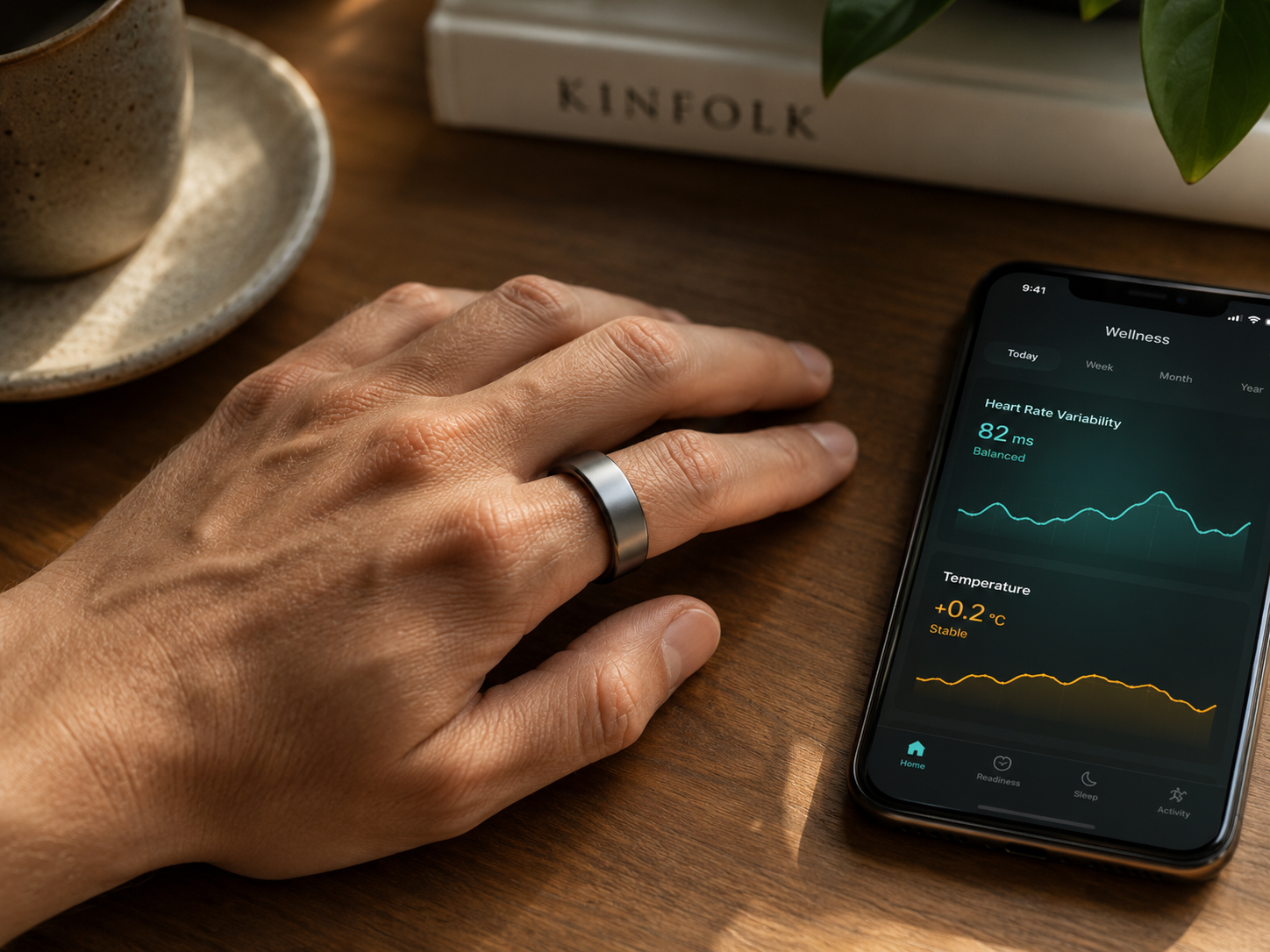
Every morning, millions of people wake up, glance at their finger, and check a score. Sleep: 84. Readiness: 71. The Oura Ring has turned the body’s quietest signals, like heart rhythm, temperature, and breath, into numbers you can actually see.
But here’s the question almost nobody asks: what do you do with those numbers?
Most people watch them. At Frequency Research Foundation, we work with them. Your Oura data is one of the most valuable inputs we have for setting up your frequencies correctly, tracking whether they’re working, and adjusting your protocol week by week. This post explains what the ring measures, why it’s worth the investment, and how we turn that data into a personalized frequency program.
What the Oura Ring Actually Measures
The newly released Oura Ring 5 is the world’s smallest smart ring. It’s 40% thinner and lighter than its predecessor, made of waterproof titanium, and runs up to a week on a single charge. Inside that tiny band sits a research grade sensor stack: red and infrared LEDs for blood oxygen, green and infrared LEDs measuring heart rate and heart rate variability around the clock, a digital temperature sensor, and an accelerometer tracking movement 24/7.
Because it sits on your finger, where arteries run close to the skin, it captures remarkably clean signals. Oura reports 99% heart rate accuracy compared to ECG and 95% sleep staging accuracy against clinical sleep labs. Across 50+ health metrics, the ones we care about most are:
Resting heart rate and heart rate variability (HRV). HRV is the subtle variation in time between heartbeats, and it’s one of the best available windows into your autonomic nervous system. High HRV generally signals a body in balance, while suppressed HRV signals stress, inflammation, or an immune system under load.
Skin temperature trends. Oura measures your temperature throughout the night and compares it to your personal baseline. Deviations of even a fraction of a degree show up clearly, often before you feel anything at all.
Sleep architecture. Deep sleep, REM, light sleep, regularity, and nighttime movement, all summarized in a nightly Sleep Score.
Respiratory rate and blood oxygen. Overnight blood oxygen sensing reveals breathing disturbances, and shifts in respiratory rate are another early flag that something is challenging your system.
Readiness and daytime stress. Oura synthesizes everything into a daily Readiness Score, alongside continuous stress and heart health tracking through the day.
The result is a continuous, objective record of your physiology: a baseline of you, updated every single night.
Is It Worth the Investment?
Let’s address it directly. The Oura Ring isn’t cheap, and full access to your data requires an Oura membership subscription on top of the ring itself. So why do we consider it one of the best health investments you can make?
Because of what you’re actually buying: continuous visibility into your own physiology.
Think about how health monitoring normally works. You see a doctor once a year. Blood pressure, maybe some bloodwork, a single snapshot of a single day. If something starts going wrong in month three, nobody knows until month twelve, or until symptoms force the issue. You’re navigating your health with one data point per year.
The Oura Ring replaces that snapshot with a film. Every night, it records your heart rate, HRV, temperature, breathing, blood oxygen, and sleep quality, then compares them against your own baseline, not a population average. That’s the critical difference. A resting heart rate of 62 means nothing in isolation, but a resting heart rate that has quietly climbed from 55 to 62 over three weeks means something is going on. Only continuous data can show you that.
This is why early detection is the ring’s real value. Illness, chronic stress, overtraining, and inflammation all leave fingerprints in your nightly data days before you feel them. Catching a problem at that stage, when it’s small, cheap, and fast to address, is worth far more than the price of the ring. One avoided week of being knocked flat, one health issue caught early instead of late, and the investment has paid for itself.
And unlike most wearables, the ring asks almost nothing of you. No screen demanding attention, no daily charging ritual, nothing to remember. It weighs a few grams, lasts up to a week per charge, and works while you sleep, which is precisely when your body reveals the most.
For our clients, there’s one more multiplier: the ring makes your frequency therapy measurably better. Without objective data, you’re relying on how you feel, which lags, fluctuates, and deceives. With it, we can set up your protocol around your real physiology and verify results in the numbers. If you’re already investing in your health through frequency work, the ring is what turns that investment from a hopeful experiment into a managed, evidence driven program.
Why This Data Is Gold for Frequency Therapy
At Frequency Research Foundation, our entire approach is built on a simple principle: your body is unique, and your protocol should be too. That’s the heart of our TEHS Scrum Framework for Health and Performance, which combines frequency based technologies with the Mobius loop concept through short weekly sprints, daily check-ins, and constant adaptation based on real feedback.
The challenge with any health intervention has always been the feedback loop. How do you know it’s working? Waiting for symptoms to appear, or disappear, is slow and subjective.
The Oura Ring closes that loop. Here’s how we use it:
1. Detecting problems before symptoms do
Your nightly temperature trend is remarkably sensitive. When a pathogen begins to challenge your immune system, your body’s thermal regulation shifts, often days before you feel run down. When a client’s Oura data shows a rising temperature deviation alongside a dip in HRV and a climbing respiratory rate, that’s our signal to look closer.
This is where our Resonant Diagnostics process comes in. An early Oura alert tells us when to investigate, and our diagnostic work tells us what we’re dealing with. From there, we can identify and set up the specific frequencies that target the issue while it’s still small.
2. Setting frequencies up correctly for your body
No two clients get identical protocols. Your baseline HRV, your sleep patterns, and your recovery capacity all shape how we sequence and prioritize frequencies. A client whose Oura data shows chronic HRV suppression and poor deep sleep needs a different starting point than an athlete optimizing for performance. The data lets us set up your frequency program around your actual physiology, not a generic template.
3. Verifying that frequencies are working
This is where the ring earns its keep. After we set up a frequency protocol, we don’t guess. We watch the data. Clients running their frequencies consistently report the changes we look for: temperature deviation returning to baseline, HRV recovering, deep sleep rebounding, and Readiness scores climbing back into the green.
If the data moves, the protocol stays. If it doesn’t, we adjust in the next weekly sprint. That’s the Mobius loop in action: continuous inspection and adaptation, powered by objective numbers instead of guesswork.
4. Fueling the weekly sprint
In the TEHS framework, every week is a sprint. Review the data, run the protocol, check the results, adapt. Your Oura trends become the sprint review. Over months, this compounds, and clients don’t just feel better, they can see the trend lines proving it.
A Typical Pattern We See
A client’s Readiness drops from the 80s into the 60s. Temperature deviation: +0.4°C. HRV down 15% from baseline. No symptoms yet.
We run diagnostics, identify the challenge, and set up the targeted frequencies. Within days, the temperature line bends back toward baseline. HRV recovers. Readiness climbs. The client never lost a week to feeling terrible, because the data let us act early.
That’s the promise of pairing continuous biometric monitoring with personalized frequency therapy: twice the energy, half the stress, and a feedback loop that never sleeps, even when you do.
Getting Started
You don’t need to be a data scientist, and you don’t need to figure out the data alone, which is where most ring owners get stuck. You need a ring, a baseline, and a team that knows how to read the signals. That last part is what we do.
Frequency therapy is one piece of a broader approach at Frequency Research Foundation. You can explore the full range of services we offer to see how everything fits together, from Resonant Diagnostics to personalized frequency programs.
Whether you’re already wearing an Oura Ring and sitting on months of untapped data, or you’re just starting to think about frequency therapy, the next step is the same. Book a consultation, and we’ll show you what your physiology reveals and how a personalized frequency protocol can move it.