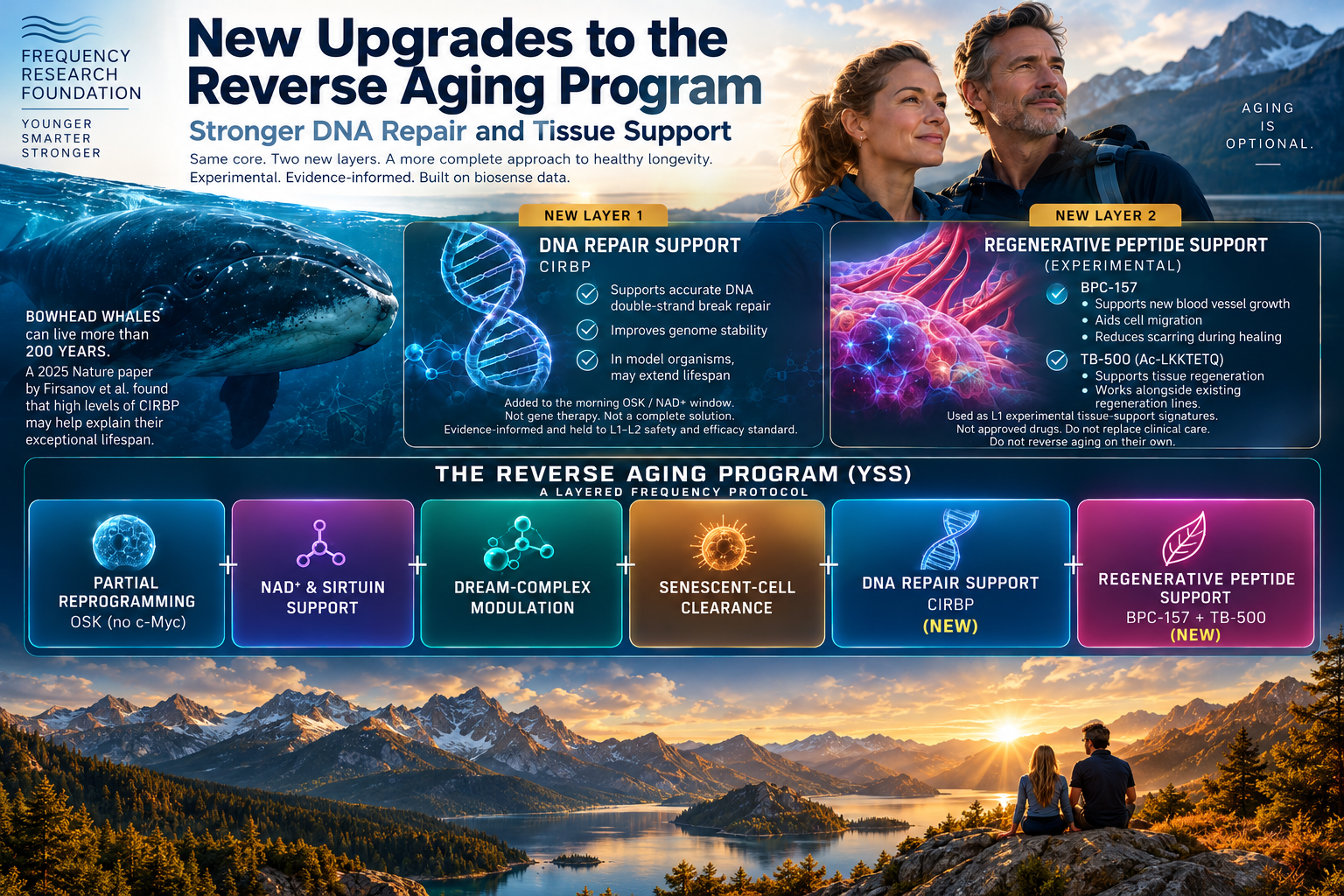
Starting today, the Reverse Aging Program uses the FaceAge research tool from Mass General Brigham as its main outcome measure. A program that aims to make you younger needs a number that can go down. FaceAge gives us one, from a single photo.
For the past year we have tracked progress with face photos and performance metrics. This month, Mass General Brigham researchers published the largest validation of photo-based biological age to date, in The Lancet Digital Health. Their web app is free to use, and it now becomes our standard.
What FaceAge is
FaceAge is an AI model that estimates your biological age from a photo of your face. It comes from the Artificial Intelligence in Medicine (AIM) Program at Mass General Brigham and Harvard Medical School.
The newest version, FAHR-FaceAge, was published this week in The Lancet Digital Health (Haugg, Lee, et al.). Here is what the team reported:
- Training: A foundation model pretrained on more than 40 million face photos, then tuned for age on about 743,000 labelled photos.
- Accuracy: An average error of 5.1 years on public datasets, holding up across the whole human lifespan.
- Validation: Tested on 38,183 cancer patients at six Harvard-affiliated sites, and confirmed on 4,892 patients in the Netherlands.
- Why it matters: Looking older than your age predicted shorter survival. That held after adjusting for age, sex, and cancer type.
- The size of the effect: 21% of patients whose FaceAge was more than 20 years above their real age died within 90 days. For patients who looked at least 10 years younger, it was about 6%.
- Hard to fool: Makeup, lighting, camera angle, facial expression, eyelid surgery, and facelifts did not change the estimate significantly.
The model reads specific parts of the face: the temples, the forehead above the eyes, and the nasolabial folds. Lead author Dr. Raymond Mak noted these are the same signs Hippocrates described around 400 BC: “the nose sharp, the eyes sunken, the temples fallen in.”
A second 2026 paper from the same group, in Nature Communications, looked at the rate of facial aging over time. That is the question a reverse-aging program cares about most: is the number moving, and in which direction?
Why we’re switching to FaceAge from Mass General Brigham
We previously used a different FaceAge service, but results did not reliably reach clients by email. The Mass General Brigham app is run by the team that built and published the model, so clients get the current version straight from the source.
It also adds features we need for tracking:
- Daily tracking: You can return every day and see how your FaceAge changes.
- History from old photos: You can upload photos from earlier years to see your trend before you started the program.
- An account: Your results stay in one place over time.
One point to be clear on: the app is a research study. When you sign up, you consent to take part, answer a short survey, and your photos are used for Mass General Brigham’s aging research. Mass General Brigham is not affiliated with Frequency Research Foundation and does not endorse the Reverse Aging Program. We use their public tool as an independent yardstick.
How to take your FaceAge measurement
The whole process takes under 10 minutes.
- Go to faceage.bwh.harvard.edu and select Join the Study.
- Create an account, then read and complete the research consent form.
- Answer the short demographic and health survey.
- Take a photo with your device, or upload one.
- Your FaceAge estimate arrives by email. Log it alongside your other program metrics.
For a baseline: Upload a few photos from the past several years as well as a new one. This shows your trend before the program starts.
For consistent readings:
- Use the same setting each time: same room, same time of day, face straight to the camera.
- Use a clear, well-lit, unfiltered photo. No beauty filters or heavy editing.
- Take several photos per session and use the average, not a single reading.
- Measure at regular intervals, for example monthly, rather than reacting to one day’s number.
What FaceAge can and can’t tell you
FaceAge is a peer-reviewed measure that beat the benchmark models it was tested against, but it has limits. We want clients to read their numbers with those limits in mind.
- One reading is noisy. The average error is about 5 years. A change of a year or two between single photos is within normal variation. Trends across many photos mean more.
- It was validated in cancer patients. The survival results come from people receiving radiotherapy. Whether the same link holds in healthy adults is still being studied.
- It measures appearance, not cells. As Professor Miroslaw Bober of the University of Surrey put it, the model “estimates age from facial appearance rather than directly measuring any underlying biological ageing process.”
- It hasn’t been tested as a measure of treatment. No study yet shows that lowering your FaceAge with an intervention lowers your health risk. A younger FaceAge is an encouraging sign, not proof of rejuvenation.
- It is a research tool. The researchers and outside experts call it a promising proof of concept that is not yet ready for clinical use.
That is why FaceAge sits alongside our other tracking: performance metrics, and whatever measures your physician already uses. It is a practical, independent check, not the whole story.
Getting started with FaceAge
If you are on the Reverse Aging Program, set up your FaceAge account this week and record a baseline. If you are considering the program, take your FaceAge first. Either way, you will have a number to watch.
Aging is not solved. But now we can watch the number.
Jeff Sutherland, Ph.D. Chief Scientist, Frequency Research Foundation
References
- Haugg F, Lee G, et al. Foundation artificial intelligence models for health recognition by use of face photographs (FAHR-Face): a model development and validation study. The Lancet Digital Health, 2026.
- Bontempi D, et al. FaceAge, a deep learning system to estimate biological age from face photographs to improve prognostication. The Lancet Digital Health, 2025.
- Face aging rate quantifies change in biological age to predict cancer outcomes. Nature Communications, 2026.
- Howard J. How a photo of a person’s face could help predict whether they’ll survive cancer treatment. CNN, October 20, 2026.
- FaceAge study app, AIM Program, Brigham and Women’s Hospital.
Note: This post is for information only and is not medical advice. FaceAge is a research tool run by Mass General Brigham, which is not affiliated with Frequency Research Foundation and does not endorse our programs. The Reverse Aging Program is frequency support, not a medical treatment. Consult a qualified physician for any clinical decisions.